9.27.2007

Where vehicles are left to die

here are some examples of vehicle cemeteries around the world, areas on earth that have unwittingly become the home to rusting, unused machines - remember, this is just a selection of the many boneyards on earth and while they often look stunning and make for a great photo, the environmental costs far outweigh the view.


(photos found on flickr link to source)


- ships


bay of nouadhibou, mauritania


welcome to the bay of nouadhibou, mauritania, an area containing over 300 ships which have been abandoned during the last 20 years.


until recently the attraction of this particular area for frustrated boat owners was, unsurprisingly, money. in order to avoid the high costs needed to discard a ship properly, people from all around the globe slowly realised that the harbour authority in this particular bay was corrupt and would turn a blind eye to any decaying vessel in return for a cheeky backhander.


the result can be seen below. it’s a surreal, haunting image. there’s an unembeddable clip of some of the dead ships here.


have a look on google maps here.


- mining vehicles


consolidated diamond mine, oranjemund, namibia


i found this brilliant photo on flickr (click pic to go source) and, according to the description, once a piece of mining equipment or a mining vehicle enters the consolidated diamond mine in oranjemund, namibia, it’s never allowed to leave. for that reason there’s a huge vehicle graveyard near the mine. considering the mine apparently owns the largest private earthmoving fleet in the world, that must be a huge boneyard.


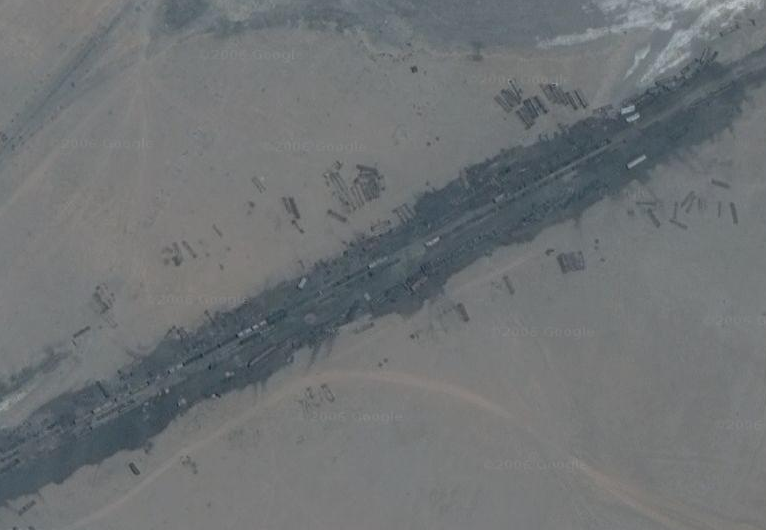
i’ve had a look on google maps for the boneyard but the area is massive. the picture below is of a collection of machinery i found - whether it’s the correct collection i don’t know. take a look on google maps here.



- planes


amarc/the boneyard, tuscon, arizona


home to over 4000 aircraft, amarc (aerospace maintenance and regeneration center) is managed by the us airforce material command who claim to carry out ‘a continual process of anti-corrosion and re-preservation work’ in order to stop the unused aircraft damaging the surrounding environment. whether that’s the case or not, i don’t know.


either way, it’s an immense amount of aircraft in such a relatively small area.


take a look on google maps here.


a drive through the area…


- trains


train cemetery, uyuni, bolivia


a kilometre outside the town of uyuni in bolivia is the train cemetery, a resting place for dozens of old steam engines along a short length of unused track. pretty much all of the trains are comlpetely covered in rust and way beyond any kind of repair, the eerie sight attracting a large number of tourists each year who have come to the area to see the world’s largest salt flats (salar de uyuni) and a few locals on the hunt for scrap metal.


the area on google maps can be found here.


- nuclear-propelled submarines


various harbours, far east russia


frightening but true.


following the cold war, russia is now home to the largest fleet of nuclear-propelled submarines in the world, a large percentage of these currently out of service and residing in harbours on the eastern coast of russia in various states of decay, the main reason for the neglect apparently being lack of funds. these areas have become known as the ’submarine cemeteries’.


here are some photos from just a couple of these harbours.


zvezda


above: 2 unused submarines at zvezda shipyard.


below: a similar scene on google maps. direct link here.


chazma bay


above: submarine reactor compartment units floating in chazma bay.


below: a simliar view on google maps. link here.


sources: 1, 2, 3, 4, 5

9.08.2007

The 5 Keys to Success in Foreign Language Learning

Note: These guidelines should be rigorously followed, even if you are taking a language course.

1) Spend the time!

By far the most important factor is how much time you are immersed in the language. The more time you spend with the language, the faster you will learn. This means listening, reading, writing, speaking, and studying words and phrases. This does not mean sitting in class looking out the window, nor listening to other students who do not speak well, nor getting explanations in your own language about how the language works. This means spending time enjoyably connected to the language you are learning.

2) Listen and read every day!

Listen wherever you are on your MP3 player. Read what you are listening to. Listen to and read things that you like, things that you can mostly understand, or even partly understand. If you keep listening and reading you will get used to the language. One hour of listening or reading is more effective than many hours of class time.

3) Focus on words and phrases!

Build up your vocabulary, you’ll need lots. Start to notice words and how they come together as phrases. Learn these words and phrases through your listening and reading. Read online, using online dictionaries, and make your own vocabulary lists for review. Soon you will run into your new words and phrases elsewhere. Gradually you will be able to use them. Do not worry about how accurately you speak until you have accumulated a plenty of words through listening and reading.

4) Take responsibility for your own learning!

If you do not want to learn the language, you won’t. If you do want to learn the language, take control. Choose content of interest, that you want to listen to and read. Seek out the words and phrases that you need to understand your listening and reading. Do not wait for someone else to show you the language, nor to tell you what to do. Discover the language by yourself, like a child growing up. Talk when you feel like it. Write when you feel like it. A teacher cannot teach you to become fluent, but you can learn to become fluent if you want to.

5) Relax and enjoy yourself!

Do not worry about what you cannot remember, or cannot yet understand, or cannot yet say. It does not matter. You are learning and improving. The language will gradually become clearer in your brain, but this will happen on a schedule that you cannot control. So sit back and enjoy. Just make sure you spend enough time with the language. That is the greatest guarantee of success.

5 Great Reasons to Learn a Foreign Language

1. Improve your English - I know this might not make sense at first but hear me out. As a person who speaks only one language you have no basis for comparison; all you know is English. In different languages the same idea is often expressed in different ways. Knowing another language gives you a great measuring stick. It will help you better understand tenses, prepositions, and all the other parts of speech we normally take for granted. You will find yourself speaking and writing more precise creative sentences. There is a reason most great writers and poets are students of many languages.

2. Enhance your travel experiences - Traveling is one of the great joys of life and also one of the most expensive. Why not get the most out of your experience? As a person who doesn’t know the native tongue you are completely excluded from the culture. The locals shun you and you are relegated to sightseeing and taking cheesy photos. Knowing even a few phrases of the language will make a huge difference. You will meet many more people and find it much easier to get around. People are much more receptive if you make an effort to speak their language. This can turn a frustrating experience into the trip of a lifetime.

3. Languages are beautiful - Language is what makes us human. It is the medium we use to share our thoughts with the world. Could you imagine thought without language? Great language also has a wonderful musical quality. Learning a new language is like learning a new way to think and a new way to sing. I am often struck by new phrases that are profoundly meaningful and melodic. At those moments I feel grateful to be alive. Don’t sell yourself short by stubbornly ignoring every language but one.

4. Join the global community - Believe it or not, the majority of the world does not speak English. We are so isolated that we hardly realize this. The truth is new thoughts and ideas are happening everywhere and they are not being immediately translated. The world is getting smaller and we are coming into contact with more non-English speakers all the time. Gain an advantage for yourself in business and personal relationships by being able to communicate with people in their language. This will set you apart and gain you immediate respect and credibility.

Last, but not least:

5. It’s just plain sexy - I’m not saying you should learn a few corny Italian pickup lines and go saying them to everyone you meet, but knowing a foreign tongue and applying it tastefully is undeniably attractive. It implies education, good taste, and refinement, and it will certainly make you standout against the competition. Imagine saying a beautiful phrase with perfect pronunciation to a lovely coed. You will immediately have her attention; she will be dying to know what it means. I know this from experience.

Now that you are dying to improve your mind by learning a foreign language you are probably wondering how to go about doing it. The task appears daunting at first, but have no fear, in my next post I will detail how to teach yourself a foreign language in less than an hour a day. I’ve developed this method through personal trial and error, and trust me, it works much much better than the way your were taught in school. And best of all, it’s tons of fun. Once you start making progress you won’t want to stop.

How to Teach Yourself a Foreign Language

For anyone who doesn’t understand why learning a foreign language is a good idea, read 5 Great Reasons to Learn a Foreign Language. Everyone else, let’s get started.

Note: I don’t claim that following these instructions will make you fluent. Fluency requires time and immersion. What this post will help you do is become conversant. You will be able to have a simple conversation, ask for directions, order at a restaurant, make small talk, etc. You will also be able to read fairly well with the use of a dictionary. Following these steps will give you a great base in a new language.

Course Materials

The first step is acquiring the materials you will use to teach yourself. The first thing you need is an audio language course. This is essential for developing your basic vocabulary and, more importantly, your pronunciation. I can personally recommend the Pimsleur Language Programs (aff) because that is what I use and I’ve had a great experience with them. Pimsleur uses memorization techniques and question and answer prompts to keep you involved in the lesson and help you retain what you learn. The lessons are about 30 minutes long. A great place to do them is during your commute. This saves you time, makes the drive go faster, and is surprisingly fun. If you don’t want to go with Pimsleur there are plenty of alternatives, but from what I’ve read they are not as engaging.

The next thing you’ll need is a basic grammar guide and a dictionary for the language you want to study. This will help you understand the basic mechanics of the language and the differences and similarities with English. You will use this continuously as a reference.

You should also get some interesting books in the language. For me this is a huge motivator because reading something interesting is much more rewarding than reading a text book. The way to go in the beginning is dual language books (aff). These have the original language on the left side and a literal English translation on the right. This allows you to start reading great books without having to reach for a dictionary every other word. It is also great for learning idioms, expressions, and verb tenses.

Getting Started

Once you have your materials you are ready to learn. Start off by doing the first lesson of your audio language course. Continue doing a lesson a day. You can do these on your commute or while you exercise to save time. For a while I did lessons while walking up and down the stairs of my apartment building. (No, I don’t care if people think I’m weird.)

In conjunction with this you should read your introductory grammar guide. This will give you a foundation in the language and help you learn the different parts of speech and their English equivalents. Don’t worry about memorizing every single rule. It simply isn’t possible. The idea is to get a general understanding first. This is the most boring part of the process, but don’t give up because it’s well worth it.

Making Progress

When you finish the grammar guide you will also have completed several days of audio lessons. At this point you will feel much better about your learning ability. You will know the important basic phrases and speak much more naturally. This method of learning is much more effective than traditional school teaching because you are actively engaged the entire time. The audio lessons force you to listen and speak more than I ever did in school.

Now it’s time to start reading those dual language books. Digging into some interesting material will build your vocabulary. Whenever possible always read aloud. This helps your speech, memorization, and makes you start thinking in the new language. I’ve found reading and doing the audio lessons concurrently enhances both experiences. During the lessons, being able to visualize words makes them easier to understand. Likewise, while reading, the pronunciation experience improves your internal monologue.

Don’t be in a rush. Read slowly and reread until you understand. Don’t hesitate to look up verb conjugations in your grammar guide. The same goes for the audio lessons. If you have trouble with a lesson, repeat it the next day. As the lessons get more complicated, I start doing them twice. The second time is actually more enjoyable. Hitting each phrase right on the money is a huge confidence booster.

Be consistent

It is extremely important to study for a short time every day. Daily repetition makes the language second nature. It is much better to read for a short time every day than to put in several hours once or twice a week. When you get a spare minute, try finding new things to read online. You will be surprised how good your comprehension is.

After a few months of consistent practice you will really start to see progress. Beautiful foreign phrases with be stuck in your head, your pronunciation will be damn near decent, and you will be able to read and understand whole paragraphs. Once you make it this far, you’ll have some serious momentum going. You will understand more than you ever did in school and you won’t want to stop.

Taking off the Training Wheels

Eventually you will complete all the audio lessons and a couple dual language books. You’ll be able to read well with a dictionary and carry on simple conversations. You are now ready to spread your wings and fly. Start reading the greatest books in your language and use a dictionary when you need to. Find someone who speaks your new language and talk to them. Go to online forums for your new language and make an email buddy. If you can, plan a trip to a country that speaks your language and experience the local culture. If you are curious about another language, then start learning that too!

Regardless of how you use your new language skills, you will have become a more educated interesting person. More importantly, you will have proven to yourself that you are much smarter than you thought.